It’s been almost four months since my mom died, and I have to say, the third month has been the toughest so far. Everything feels harder. I miss my mom. I can’t believe she’s gone. I hurt every day, some days more than others.photo
In my cycle of grief, as a wise social worker friend calls it, I’m at a stage where my nerves, and my patience, are dwindling. I feel sort of numb and punchy.

People ask me how I’m doing, and in the moment of their asking, I usually don’t know what to say. I tend to respond, “good” or “fine.”

With a few extra moments today to ponder the question, I wanted to offer a more detailed response.

1. I’m feeling un-tethered.

For 37 years, I navigated my life around my mom’s opinions, whether or not I agreed with them. Now that I have freedom from her views and expectations, it’s both liberating and guilt inducing. Being un-tethered in this way leaves me feeling sad and lost.

2. Milestones are tricky.

At my cousin’s bat mitzvah recently, three of my family members and I were saying Kaddish (the Jewish mourning prayer) for my mom or my cousin Selma. We stood in a circle, composed of more than 10 friends and family (a minyan), and recited the prayer by heart, weeping. It was a remarkable and painful moment. During special occasions and also during daily humdrum ones, happy and sad are intertwined like this for me right now.

Other milestones, such as toilet training my younger son, would have elicited emotions from my mom. I want to call her and talk about them.

My mom used to call me every Sunday and Wednesday nights like clockwork. My dad is trying to keep up this routine, but he’s by nature more fluid about communication. Sometimes I hear from him by email, sometimes we call each other in the morning. This whole business of not hearing from my mom on a regular schedule is eerie. It just feels wrong, even though I personally prefer it this way.

3. I’ve become more empathetic.

I’m more attuned now to other people’s tragedies. It feels like mourning-radar. (Mourndar!) When an acquaintance or close friend loses a loved one, I try to respond quickly. When I heard about Malaysia Airlines Flight 370 being concluded a total loss in the Indian Ocean, I was brought to tears. I just felt tremendous empathy for the victim’s families. At least my family and I knew my mom’s death was coming. These families had no warning. The victims, too: they lost their lives in an instant, possibly in an unconscious one. It’s just all such a shame.

4. Her “sunshine” lingers.

As an adult, I never cared much for “You Are My Sunshine” – my mom’s favorite song to sing to me and my sister when we were kids. She always got wistful when she sang it to us, and the whole thing just made me sad. But after she died, the song developed new meaning for me. I’m fond of it now. My younger son, Ian, adores it. We sing it together every night. Quite passionately, I might add, by his request. I often feel my mom’s presence in those moments. It’s as if she’s communicating to us through that song.

For his entire three years of life, Ian has been attached to me and clingy, but he’s taken it to a whole new level in the last few months. He’s super demonstrative toward me now. When he kisses me, he holds my face in his hands. He wants to hug me and hold my hand constantly. My mom was demonstrative, too, with her love for me and my sister. So, I see a lot of her shining through in Ian’s affections.

5. My fuse has shortened.

I don’t know if it’s sleep deprivation or mild depression, or both, but since my mom died I’ve been snippier. It takes much less for me to snap, especially at the kids. I’m aware of this, but often feel incapable of changing it. I’m trying to remove myself now from situations that I can tell I just won’t be able to handle. If it’s bedtime, for example, and I’m exhausted and the kids aren’t cooperating, I’ll just walk away for a minute. Sometimes, the kids even get the hint and change their behavior. (Sometimes.)

I used to be able to stay the course in the kid chaos, and right it. But now, I’m finding it more difficult to do that.

6. I’ve become a weather girl.

A friend told me recently she was visiting Mount Hebron, the cemetery where my mom is buried in New York. This friend offered to visit my mom, but offhand I didn’t know her exact “address.” This was a weird realization, that I didn’t know my mom’s address. But I do visit her often in my mind. And I check to see the weather in New York. My mom always got cold easily, so it upsets me when it’s cold or rainy in New York. She’s gotta be cold, I think, irrationally.

7. My worry has transferred.

For the five years between my mom’s breast cancer diagnosis and her death, I worried about her health. Now, I worry about my dad being alone in Florida. What if something happens to him? How will we know?

He had several wisdom teeth pulled recently, and I couldn’t just pop over and check in on him. He also wouldn’t answer my questions about how he felt. Was he in pain? Why wouldn’t he just tell me?! He doesn’t complain much, which can be both a blessing and a curse.

After my mom died, I thought maybe I’d free up some worry-filled mental space, but I’ve found that I haven’t. My worry has transferred from my mom to my dad.

8. My misery seeks company. Sometimes.

It’s that “mourndar” thing again. I seem to be sniffing out others who have experienced loss. At a recent event for my sons’ preschool, for example, I found myself talking with a friend who also joined the “Dead Mothers Club” in December. It sounds morose, but when he jokingly referred to us in that way, it kind of fit. Each day it hits us anew that our mothers are really gone. It feels comforting to commiserate with him and others about things like this.

And yet, there are many times I find myself retreating. I don’t return phone calls as quickly – even to closest of friends and family. Mourning, it seems, has given me a free pass to self-isolate. Many times I just don’t feel like talking. I prefer to be left alone.

9. I fear I’m falling short.

I’m torn between respecting my mom in the way she wanted me to and being here in the present for my family. In both ways, I feel as though I’m falling short.

I’m not watching frivolous TV or listening to popular music. I’m refraining from going to parties and celebrations unless they’re the size of a Shabbat dinner or for a cause I’m involved in and expected to attend. I’m saying Kaddish twice a day.

During my mom’s memorial service here in Charlotte, my rabbi said my adherence to these traditional mourning practices will help me face my grief head on, and not avoid it. I hope this will be true – that I will heal better in the long-term as a result. But it all feels so hard right now. It just feels like more loss. I miss watching mindless TV with Josh, going on date nights to the movies and listening to things other than NPR or classical stations on the radio while driving the kids to school.

10. I still can’t believe it.

I’ve heard people say this, but never fully understood what they meant until now. I simply cannot comprehend that my mom has died. I was there when she drew her last breath and when her heart stopped beating. But that doesn’t mean the reality has sunk in. Her death still doesn’t make sense to me. I find myself replaying her final moments as a way to help make it feel real, but it still doesn’t.

Rabbi Mordecai Shapiro, an Orthodox rabbi who grew up with my mom in Brooklyn and officiated at her funeral, talked to me, my sister and my father as he was cutting our ribbons and garments. He said that right now, we can only pray for understanding. Maybe, one day, we will be given a birds’ eye view of the mosaic we call life, and all of the random occurrences will make sense to us. But for now, we just have to keep the faith and trust in God.

Recently, my sister’s friend said that 10 years after her mom died she still can’t believe or comprehend it. Keeping the faith is a tricky business, I’m finding.

11. Looking ahead

When I confided to a friend recently that I was feeling blah and not like myself, she asked if I had anything to look forward to. It was a wise and thoughtful question. I probably need to focus more on future plans and happier things ahead. But my mom is not in the future. And that’s a harsh reality to face, no matter how many plans I make.

Each day is a new adventure and a new opportunity for me to experience mourning. Chasing after two young kids, I find that I don’t often have time to fully process or reflect on my state of being. It’s a bit of a moving target right now.

Therefore, if you ask me how I’m doing, I might not know how to respond. But, I’ll always appreciate you asking the question.

Xo, Jodi
It’s been 25 days since my mom died. I was having a particularly tough night last night, and I couldn’t sleep. I was making to-do lists. My mind was racing about my job, making end of year donations, and worrying about my family.

Then, in a flash…I was back in the kitchen of my childhood home, in NJ. I was standing right next to Mommy. She was wearing her green striped house coat, the one with the pink and yellow across the top. It must have been the 1990’s, as she had her Linda Evans haircut.

Someone in the kitchen had been looking for dessert, and Mommy knew where the good stuff was. She held a small box of cookies (from Butterflake, for those of you from Teaneck).

I reached out and grabbed her right shoulder with my left hand. I FELT HER. And, she looked right at me. She was youthful, radiant, healthy. She wore no makeup.

And then…I was back in my bedroom in Charlotte, looking up at a dark ceiling. I told Mommy I loved her and thanked her for visiting me. It was so good to see her.

And then I broke down. My sobbing woke Josh, and he held me. The devastation hit me anew: Mommy was gone.

My in-laws, psychologists, would probably say this sighting was my brain’s way of comforting me. But, I attribute it to Mommy and to God. I had had a vision.

Whatever was at play, I was reminded that I have a lifetime of vivid memories stored away, which I can access whenever I need to reach out to Mommy.

I can’t wait to see her again. I wonder what her hair will look like next time.

On a scale of 1 to 10, it was about a 3.

In the scheme of things, it could have been a lot worse. Both of our fathers are thankfully still alive and well. We don’t live near them, sure, but we talked with one and Skyped with the other.

Josh and I are also blessed to have two healthy sons, ages 4 and 2, who are great at doing normal kid things like beating each other up and sleeping late only on weekdays. To them, Josh is a loving, hands-on father (which is especially noteworthy on Father’s Day).

And, that’s pretty much where I should stop with the good stuff accounting.

There was no cookout or family gathering. We didn’t go to the pool.  Instead, we ran errands to Costco and our storage facility. And, we bickered over dinner in front of our foreign exchange counselor.

For context, Josh had been traveling all week for work. And on Saturday, I had given him a free pass to play golf. All day. Did I mention he slept in on both weekend mornings?

In hindsight, I guess I should have done more planning. But, he never told me where he wanted to go for brunch or what he wanted to do on Father’s Day. And, he’s the spontaneous one. If I had planned, he surely would have wanted to do something else.

So, by 9:00am on Father’s Day, I was, shall we say, crispy. I went down for a nap and woke up two hours later to Josh complaining, “What kind of Father’s Day is this?”

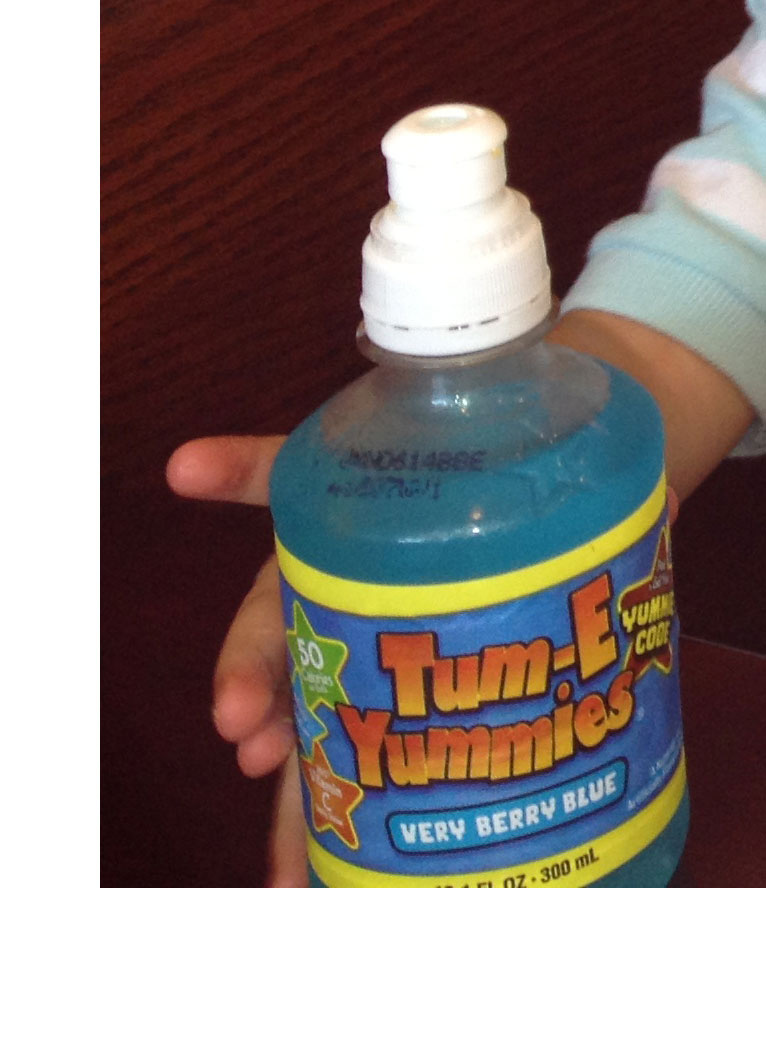
We went out for bagels, which was sort of fun. If you overlook the fact that our sons ate woefully little of their $10 nova bagel and $7 turkey sandwich. And, the fact that by the end, I was covered in a blue, 0% juice drink called “Tum-E Yummies.”

The infamous, 0% juice drink.

The infamous, 0% juice drink.

That afternoon, Josh took a solo bike ride, which was a nice Father’s Day treat. And then, at 6:45pm, against our better judgment , we took the kids out to dinner. When it comes to things like this, we tend to have short memories. We think it will just be fun. What the heck? It’s Father’s Day!

What we overlooked was how dangerously close this was to bedtime, and that the kids would be starving by the time we got to the restaurant.

Given that it was Father’s Day, I watched the kids on the playground while the restaurant cooked our food. (Yes, there was a playground in the middle of the shopping center. This IS Charlotte we’re talking about.) I also ran interference during dinner when the dumbass kitchen brought the kids food out after the adult food.

But, when Ian refused to eat the miniscule Chicken Satay skewers when they finally arrived at the table, and he also refused the veggie squeezie packet I offered him, Josh barked the equivalent of backseat driver orders for me to Just. Give. The Squeezie. To Ian. Already. After all, He’s just two!

And this is when I let Josh have it. In front of Roni, the 20-year-old Israeli counselor staying with us for the month.

It’s always nice when you yell at your husband on Father’s Day. Or, rather, give him some lingering silent treatment with a healthy dose of internal cussing.

Things sort of got better on the way home. We saw lightning bugs everywhere. And, after we hosed down the kids in the shower, they fell asleep quickly. Then Josh and I watched part of a truly incredible TV documentary about North America.

Wild and crazy times.

When we thought about the day elsewhere — about Josh’s family gathered for the weekend on Cape Cod, and my dad in Florida going for brunch with my mom and friends because my sister and I don’t live near them — we realized the full extent to which the day sucked.

And that’s the truth of it. There were no smiling photos or witty comments posted to Facebook. No memorable gift giving.

Just errands, bickering and stressful meals out with young children. Happy Father’s Day, Sweetie.

Nothing’s as bad as the Mother’s and Father’s Days when we were struggling to start our family. But this was pretty close.

Next year: let’s plan on barbequing.  I’ll buy the grub if you grill it up. And, maybe, we’ll even take the kids to the pool.

In the Summer of 2002, I attended a writers conference at what was then called Southampton College. The reason was two-fold: I had recently finished a screenplay I wanted to toss around in a workshop. And, Nora Ephron would be speaking. (Not necessarily in that order.)Image

In my pre-conference delusions, I envisioned Nora dropping in on my workshop and being taken with my romantic comedy. She would declare me her protégé, and we’d ride off into the Hollywood sunset, the new, Ephron-Werner writing team.

What transpired was more like this:

She never came to our workshop. I stood in line after her remarks one evening, and asked her to sign my copy of Crazy Salad. As she did, I told her: I admire how you write across genres! You are one of my writing inspirations! I love your films, and I attended the conference largely because of you!

At least, that’s how I remember it. Whatever I said, I’m pretty sure I gushed. And it was, in the writing sense, as though I declared my love to her.

Her verbal response: (deadpan) “Thanks.”

Her ocular response, looking past me: “Next!”

To say the least, I was disappointed. But the experience also felt strangely perfect the way it was. Like it had been scripted.

And, it resulted in some copy. So again, I can imagine, Nora would be pleased.

I have my son’s blood on my jacket, my jeans.

The phrase “falling on your face” has new meaning for our family, after Max, 4 ½, fell last Friday while running toward the playground  and didn’t get around to bracing himself first. I was talking with my friend Michelle when it happened, so I didn’t witness the fall. But the aftermath was a scene from a war film.

Max rose from the ground and ran toward me wearing horror in his eyes and coughing on the blood streaming into his mouth. My younger son, Ian, clung to my leg where he’d stay during the moments it took to seek help and get Max cleaned up.

NOT AGAIN.

Last time – just seven months prior – I hadn’t seen the fall, either. It was on the stairs at camp while Max walked down to meet me at pickup. He tripped on his backpack straps and fell nose first into the banister.

Max and his crooked nose, June 2012.

Max and his crooked nose, June 2012.

By the time I reached Max at camp, the staff had already cleaned him up, and he was holding an ice pack to his freshly crooked nose. For the week it took to surgically straighten it, I fought nausea and found it difficult to look at Max below his eyes. But I didn’t witness the bloody mess. Last week, it was the initial gore whose imagery now lingers.

These things have a way of imprinting on us parents. They add lines to our brows; they take moments, perhaps years, off our lives.

The ENT calls Max an “active” child. My father was one, too. He would eventually channel his energy through baseball and basketball, which he played throughout college. But as a boy growing up in Brooklyn, he got into a few bloody messes of his own.

At three, my dad went to the butcher with my grandmother and ran outside to swing on a gate. His thumb got caught in a hinge, and the tip was almost amputated. My grandmother, while nursing this wound and many others, yelled at him: “Why are you doing this to ME?”

The boo boos that rapidly heal on our children leave longer-lasting marks on their parents. The wrestling, rough-housing, falls and blood are all new to me having grown up with a sister and no brothers. My sister’s falling off her bike and breaking her hand was the only substantial injury I recall from both of our childhoods. I’ve already sought emergency medical care for Max twice, and he’s not even five yet.

People say boys are easier to raise – especially compared to girls’ hormones. But the grisliness of boys’ childhood injuries is emotionally wrenching for parents, too.

On Friday, after he was all cleaned up, a whole-body hug seemed to recharge Max. He smiled and asked if there would be a TV at urgent care; after all, there had been one in the emergency room over the summer. Children are more resilient than their parents. He reminds me of this often.

I practiced yoga breathing the rest of the afternoon and recharged with a bear hug of my own – from my husband. In the days that followed, I was grinding my teeth to the point of a tooth ache.

When surrounded by our children, there’s no time for parents to be visibly stressed. Those expressions must wait – often for subconscious moments. My dentist asked me recently if my gums and teeth felt more sensitive after stress. This time, the answer was evident.

This time, the urgent care doctor and Max’s ENT both came back with good news: Max broke only capillaries in his nose. A week after the bloody mess, the only scars remaining are of the mental variety. We were lucky.

The washing machine has lifted all evidence of blood from our clothes. I wish it were that way with my memory, too.

I cringe when I read the alumni notes in my graduate school’s magazine. Another former classmate has published a book. Or hosts a show on Sirius XM. Or has won some prestigious award.

Ha! I’ll do SOMETHING with this… later.

In the 12 years since graduation, many people I used to socialize with or share a round table with in writing workshops have done great things. I can read about them now. And feel the envy erupting.

Sure, I’m proud of my peers and happy for them, too. I’m not THAT jaded or jealous. I’ve also done some great, albeit tangential things myself: I helped create a film festival that’s in its ninth year and beloved by a community. I have edited web and print publications for several Jewish nonprofits. I fell in love and got married, birthing – naturally – two healthy, awe-inspiring children. I have experienced. Pushed myself physically. Challenged myself to the limit of patience and endurance.

None of which I will publish in my alumni notes. They just don’t seem to compare to publication credits or awards.

I know I’m being shallow, myopic, ridiculous. But when you spend time and money on a degree to pursue competence in something, there’s an expectation – self-imposed or otherwise – that you’ll do something great with it. And if you don’t? Well, then you shut your mouth. At least, as far as the alumni notes are concerned.

Sure, I write humorous captions for online photo albums and an occasional blog post, but I’m capable of more. If only I had time. Or energy. Or a creative spark. All three would really be fabulous.

Truthfully, I can’t blame it on lack of time. Plenty of people – hello, J.K. Rowling and Toni Morrison – wrote in the wee, stolen hours while their kids slept. I just can’t do it. I couldn’t function if I woke any earlier. And, most nights after getting the kids down, I just need an hour or so to do nothing but the equivalent of watching The Bachelor.

The creative spark? It’s there somewhere. Take, for example, while wiping snot or poop, I’ll occasionally pause and tilt my head skyward. Now, if only I had a pen. Other times, I’ll ask Max to repeat himself. “Did you just call my vagina a volcano? Ha!” And type an email to close friends and family.

The thinking: I’ll entertain in the immediate and then do SOMETHING with the thoughts later. But what is that “something?” And when does “later” start? I’m still figuring that out.

Josh and I enlisted the help of science and hormones to become parents. Personally, I did everything physically possible to become a mother, to be able to cherish these moments and to nurture my children into adulthood. I will not miss these years. Not if I don’t have to. I will work less and write less. That’s my choice. My blessing.

Which doesn’t mean that occasionally – like when that magazine arrives in my mailbox – I won’t want to bitch about the opportunity costs. Wallow in self pity. Curse at the pages of the alumni notes.

For now, I cling to the quote Nora Ephron made famous: “Everything is Copy.” And keep collecting. Until, that precious day, when I too have something to publish in those damn alumni notes.

Library and movie time on the road

August – the Sunday of summer months – has never been my favorite. I prefer June with all of its optimism, the summer stretching its tan limbs out ahead. This August in particular was more trying than usual.

On paper, it sounded idyllic: A week-long beach vacation with oodles of family, followed by three weeks of unstructured fun time with the boys. I pictured filling the last weeks of summer with playdates and the kids and I winging it. Truthfully, I was wary of the stretch of time without schedules, but I kept pushing off the thought of it all. Truly August wouldn’t come for a long time yet.

Here’s what transpired: August began with a combined 28-hour drive with our preschooler and toddler in tow – the kids did great! –  but we spent only two hours, tops, at the beach. We came home to develop a double ear infection (Ian) and two upper respiratory infections (me and Josh). Then, the A/C unit broke upstairs, which is where we sleep, and it took two out of our three “free” weeks to research and replace it. Did I mention that during our family road trip, Max got motion sickness and puked once in the car and once at my sister’s dining room table? (Sorry Stace!)

On the bright side: I finally covered with protective foam the razor sharp edge of the sofa table behind the couch. Now the boys will never realize my fears of cutting their faces open while making forts with the couch cushions and jumping across the “moat” to “safety.”

This August I also took the kids to a Children’s Theatre of Charlotte performance of Psshh!, a production created for the under-3 set, which was Ian’s first time in the theatre and which both boys adored.

We did have three play dates in August once our family was healthy again. And Max attended two amazing backyard birthday parties – one that taught him the finer things about super heroes, namely how to put the bad guys in jail. The other included a bounce house, a singing farmer, balloon figurine design and snow cones, all out back behind our friends’ house.

After a long end to summer, I admit I spent several days in bed, recovering from it all. And now, tomorrow, school starts. With that, I say a fond farewell to August. And hello, September!

I didn’t used to hate doing laundry – back in the day when I did two loads a week. Now that I do two loads a day, however, I hate it. The prospect of 14 loads over a weekend doesn’t interest me. So, the whir of the washer and flop of the dryer provide the soundtrack to most of my days.

When Josh and I first moved in together, laundry was one of our early disagreements. He stopped doing it. I started doing it more. This irked me, and I told him so.

Nowadays, with his income being exponentially more than mine, and my status being (mostly) go-at-home mom, there’s no more discussion. I do 99% of the laundry. He does an occasional white load. But there’s one place I won’t budge: sorting his work socks. The navy and black indistinguishable strips are not my responsibility. I will get them clean, and then they’re all his. The process of deciphering pairs – is that dark blue or black? I find too maddening and time consuming.

Also, the daily loads of kids’ clothes, underwear and towels: let’s be honest, they’re not getting folded anytime soon. They will sit in baskets on the floor in the hallway for days or maybe weeks at a time, until we get desperate to use them. In the meantime, the baskets will become playthings for the kids. Piece by piece the laundry comes out of a basket, then it gets thrown back in. But at least the items are clean.

And, when Josh inevitably throws one of my good shirts in with his jumbo-sized,  multicolored “white” loads and puts it through the full dryer cycle, I try to keep my mouth shut. Be thankful he’s doing laundry at all, I tell myself. Otherwise, that’s one more load to add to my responsibility list.

Which, let’s face it, is long enough as it is. So, if you see me walking around with a wrinkled or shrunken shirt, just consider it a new trend. Likely, its been the object of a basket toss or going for overtime in the dryer. And that’s just the way the laundry gets done in the Greenwald household. Until one of us has a change of attitude towards laundry, which I just don’t see happening.

May 19, 2012 – Temple Beth El – Charlotte, NC

I have to say, I was honored when Rabbi Judy asked me to deliver today’s D’var Torah (interpretation of a Torah text). Especially in light of who would be in attendance – our Robin Farber leaders, Mitzvah Day captains, high school graduating seniors, and birthright Israel alumni. What an honor, I thought. And then I read the double Torah portion. And read it. And read it again. Oh boy, I thought. What in the world am I going to do with this?

Parashat Behar-Bechukotai finds the Jewish people about to enter Israel for the first time. God stands with Moses at Sinai and dictates the rules for entry. It’s a pivotal moment, and a difficult read, for reasons I will get into in a few minutes.

I decided to focus this d’var Torah on the leadership lessons we could learn from Behar-Bechukotai. Three stood out to me: 1) how and why leaders assert their authority, 2) how and why they set boundaries and lay out consequences, and 3) how and when they show love and support to the people they lead.

As God stands with Moses on Sinai, God knows it’s now or never. The Jewish people are about to enter Israel, which is the equivalent of paradise. If no rules or boundaries or set, it’s likely to become pure chaos.

God starts by re-asserting a sense of authority. It’s interesting that after everything God has done for the Jewish people – brought plagues down on the Egyptians, parted the Red Sea, navigated the desert for 40 years without a GPS and successfully got us to Israel – God STILL feels the need to re-assert authority: I the LORD, am your God. God says it over and again.

My husband, Josh, who’s in leadership development, says, “Executives are often deemed only as good as their most recent win or accomplishment.” The lesson: Mortals’ memories aren’t so hot. Therefore, our leaders continuously need to prove themselves to us so that we don’t forget how good they really are. It’s no different with God.

After asserting authority at Sinai, God gets down to setting boundaries. It reminds me of a discussion I had in graduate school, when I was being taught how to teach writing.

A fellow teacher in training said he didn’t appreciate when teachers gave him too many rules or guidelines. If freedom were a stage, he said, he wanted to fall off it, hard. That’s how he would best learn – or create for himself – where the edge was.

I, on the other hand, wanted to know where the edge was at all times, so that I could avoid falling off the stage. Knowing the limits of my domain was how I felt I could be the best dancer imaginable. If I were always wondering where the edge was, I wouldn’t be able to lose myself in the dance.

This other teacher and I had a difference in opinion on how to handle personal freedom. We differed in how we wanted to be led. And how we wanted to teach others.

At Sinai, I believe God realizes that individuals learn differently. But God’s only got this one shot to talk some sense into the Jewish people before they enter Israel. And, I believe God was trying to prevent us from falling off the proverbial stage.

So, God details harsh rules and consequences, as well as a few rewards. What would be the use, if after we finally entered Israel, we missed out on enjoying paradise because we foolishly partied too much, destroyed the land, or hurt each other?

God says to the Jewish people: “If you follow my laws and faithfully observe My commandments, I will…look with favor upon you and make you fertile and multiply you.” God also says: “But if you do not obey Me and do not observe all these commandments…You shall flee though none pursues”… “You shall eat the flesh of your sons and the flesh of your daughters.”

Yikes. I think God at Sinai is trying to be as harsh on us as he can be, so that we will listen. Yes, these consequences sound over the top as we read them today. But, I try to remember that there are things we too, as parents, teachers and leaders that we say too harshly. Things in hindsight that we wish we could take back or say differently. We don’t really wish to inflict psychological or bodily harm on those who follow us. We just want them to hear us and take us seriously.

At the end of this week’s parashah, we are reminded that God will love us anyway. The punishments God lists in great detail only get harsher if the Jewish people don’t listen the first, second or more times. And in the end, with repentance, we are told we can still win God back. In truth, God stays with us all the time.

To me, this is reminiscent of Maurice Sendek’s Where the Wild Things are. Sendek passed away on May 8th, but his whimsical stories and moody illustrations will leave a legacy for future generations.

The protagonist, Max, in Where the Wild Things Are, is being too mischievous one day, and his mom sends him to bed without dinner. While in his room, he imagines a whole adventure for himself in the land of the Wild Things. After a while though, he is lured back to his bedroom, by the delicious smells of the dinner his mom has made for him. In the end, his mom brings dinner to his room anyway. And it’s still hot when he gets back to it.

Members of and visitors to our congregation, our high school seniors, and current and future leaders of our temple, in light of this week’s double whammy of a Torah portion, I end by asking you to reflect on the type of leader you are, or the one you are going to become. How will you assert your authority? How harsh will you be? And how forgiving? How will you encourage others to use their gifts, their freedoms, their talents? What boundaries will you set for them? Or will you let them fall off the stage for themselves?

Thank you and Shabbat Shalom.

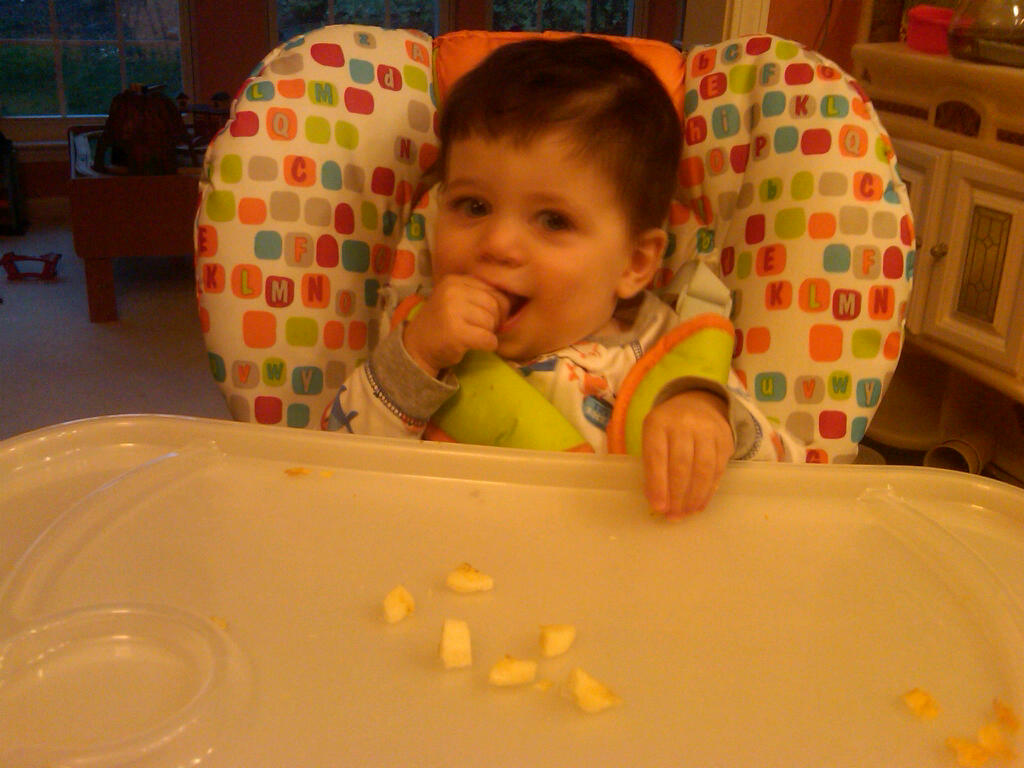
Ian woke up today and suddenly likes bananas. This is the same kid who, for the first year of his life, hated them. As a baby, he would reject the spoonful of mashed bananas. As a new toddler, he would flail his arms to knock the banana pieces away. Or better yet, he would dangle them over the side of the highchair tray, look you right in the eye with a smirk on his face and then release them.

Ma nishtanah? Why is today, Saturday, March 24th (at 7:10 am, of course) different than all other mornings? What made him decide to try – and like – banana?

Perhaps, at 13 months old, the sliminess no longer bothers him? With eight teeth, he likes that I can give him larger chunks than before? Could his taste buds have changed?

Almost four years into this parenting thing, and my kids still amaze me like the first time I saw them. Often, I’m at a loss for words or understanding. I’m just happy to be along for the ride.

Gotta run. My little monkey is grunting at me, for guess what, more bananas. And there he goes. He finished the whole darn thing. What an amazing turn of events.

The boys.